Fused OD biomass (XR)
The od_fused biomass signal is a fused optical density estimate produced from the 45°, 90°, and 135° OD sensors on Pioreactor XR. It is designed to stay informative across a wide range of turbidity without you manually switching between angles.
od_fused is available only on Pioreactor XR models.
Why multiple angles help
Scattering changes with angle and concentration. Each angle has a different sensitivity range, which means the most informative sensor can change as turbidity increases. The figure below shows how the three angles respond across a concentration sweep.
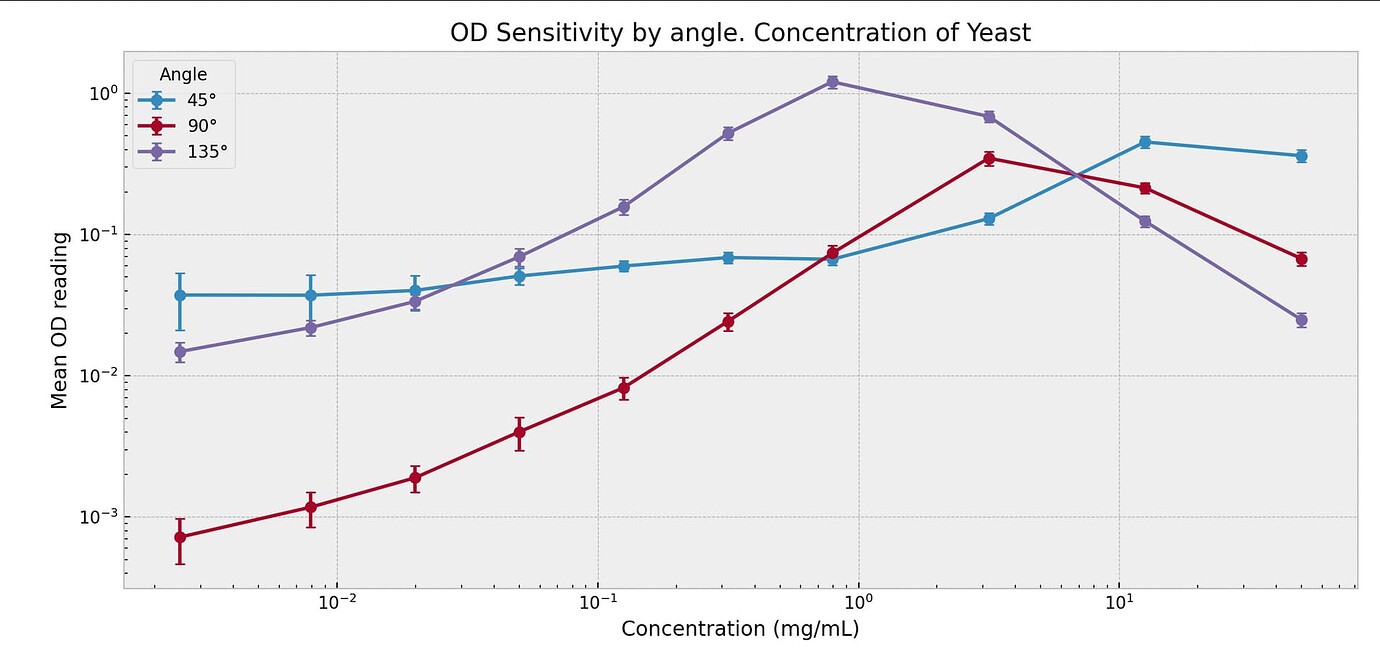
In practice, the 135° channel is more sensitive at low-to-mid turbidity, the 45° channel becomes more informative at higher turbidity, and the 90° channel tends to sit in between. The fusion model uses all three so it can stay reliable across the full range.
How the fusion model works (high level)
The fusion model treats the triplet of angle readings as a signature for biomass. It fits a curve and variance model for each angle using your standards, then estimates the most likely concentration for each observed triplet. Regions that are flat or noisy contribute less to the estimate, so the model naturally downweights weak signal regimes instead of relying on a single angle.
Create a fused estimator
In the UI, this shows up as Fusion OD using standards in Protocols.
Fusion calibration requires XR photodiodes configured for 45°, 90°, and 135° and a fixed (numeric) IR LED intensity value.
- Prepare at least four OD600 standards in Pioreactor vials (no blank required).
- Open Protocols and start Fusion OD using standards.
- Follow the steps to record each standard.
- When the protocol completes, a fused estimator is saved.
- Open Estimators and set the new estimator active for
od_fused.
The protocol fits in log-space across the three angles and stores a reusable estimator so future experiments can publish od_fused automatically.
Use od_fused as the biomass signal
When OD reading is running and an od_fused estimator is active, the fused signal is published alongside the standard OD channels. To use it in automations, select od_fused wherever a biomass_signal is accepted (for example in a Turbidostat automation or Experiment profiles).
Example experiment profile snippet:
jobs:
  dosing_automation:
    actions:
      - type: start
        options:
          automation_name: turbidostat
          target_biomass: 2.0
          biomass_signal: od_fused