Exporting data
Experiment data can be exported using the Export data tab on the Pioreactor site.
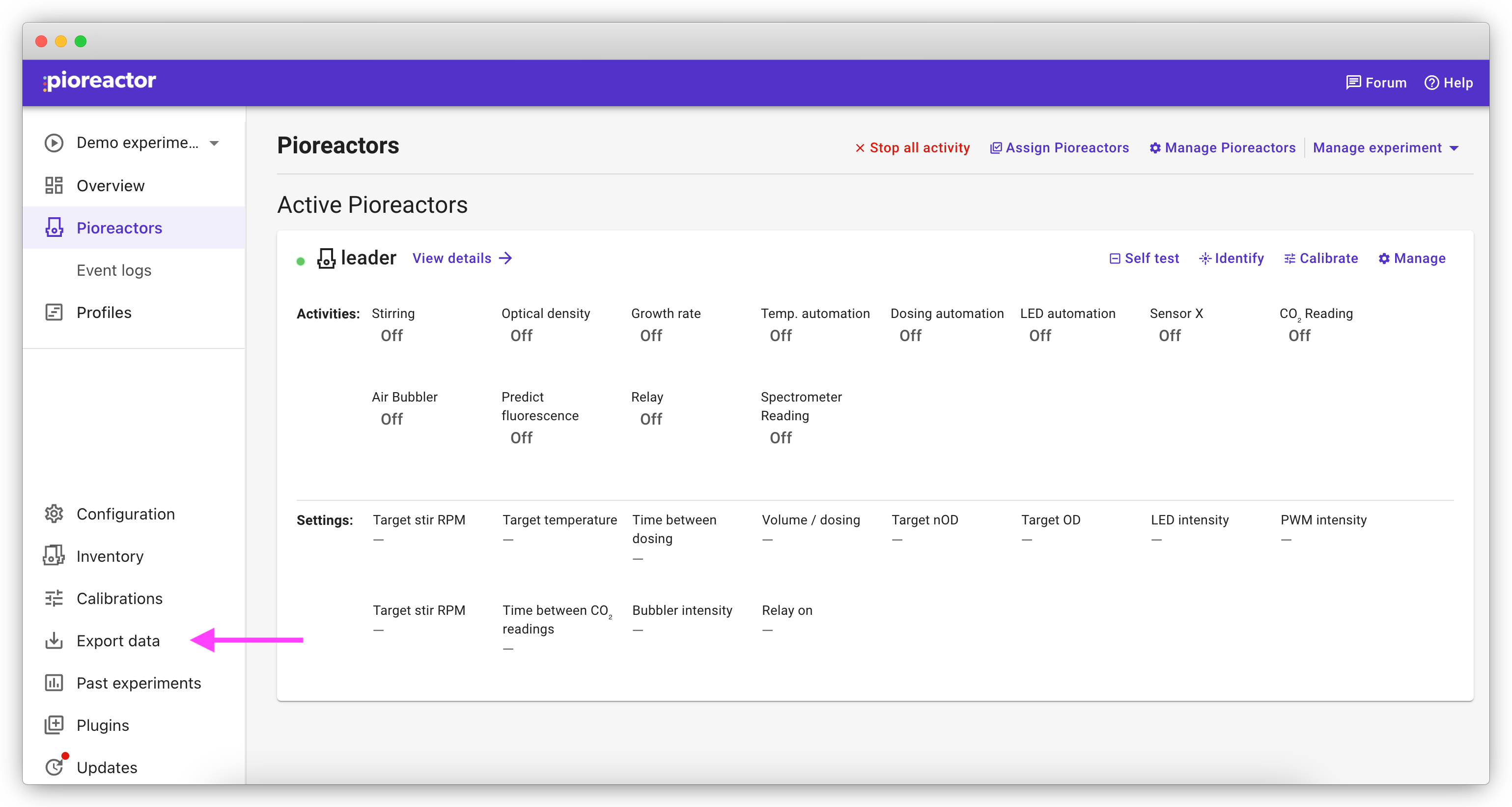
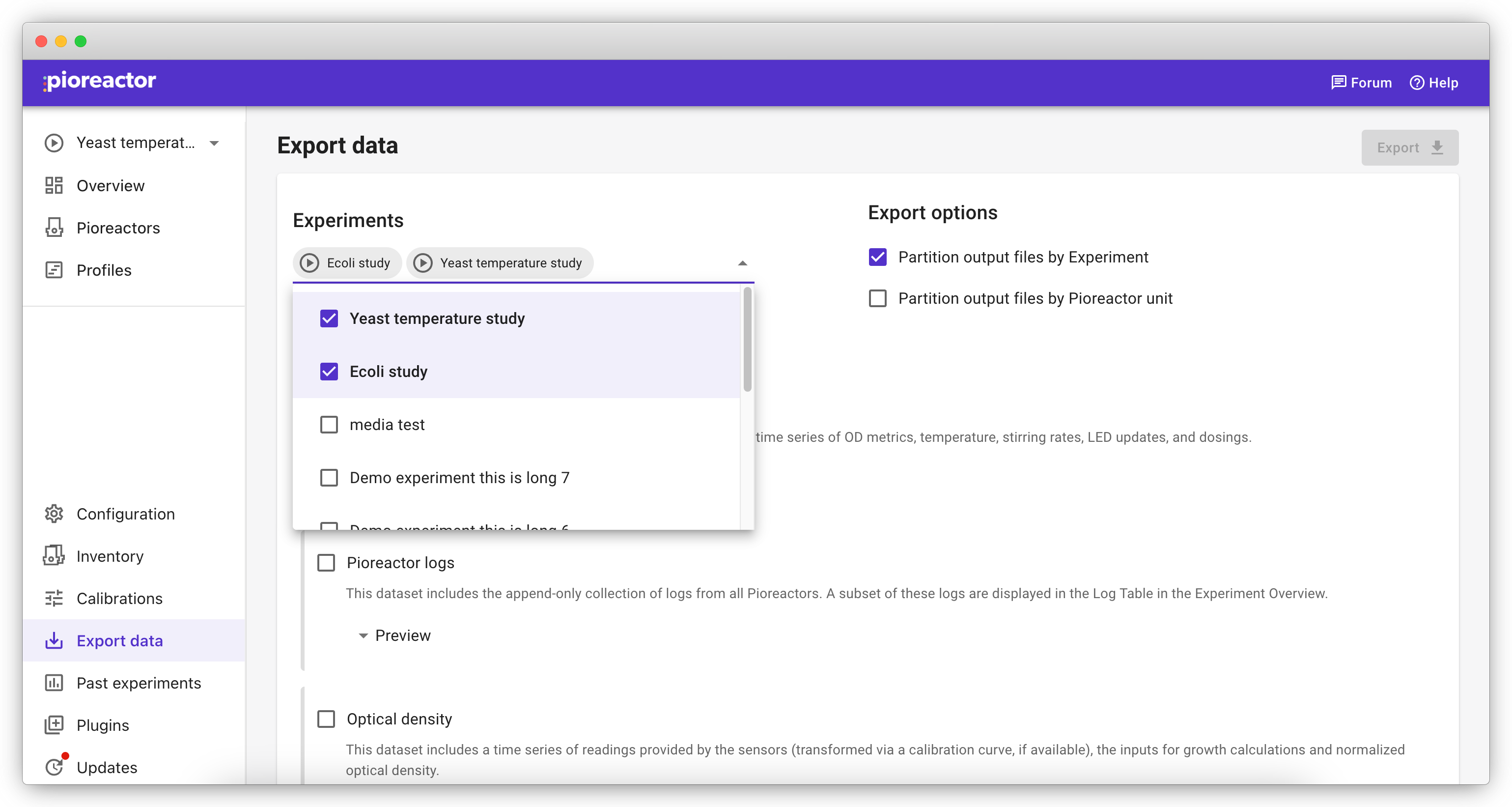
Each export contains data from one experiment. Select the experiment from the dropdown menu, or select <System> for system-level datasets such as logs that are not associated with a user experiment.
Select the datasets you would like to download.
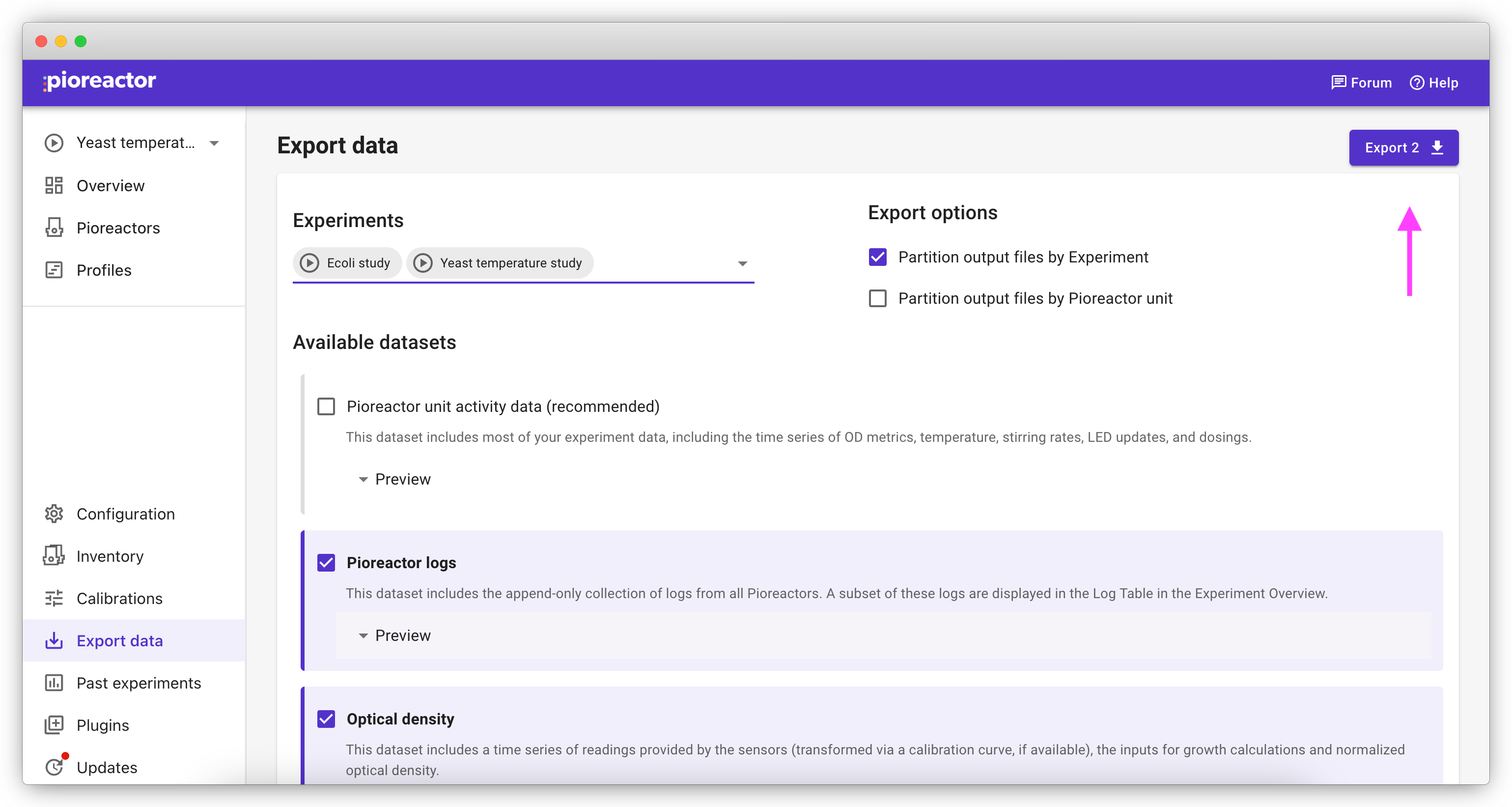
Under Export options, you can split CSV files by Pioreactor or restrict timestamped datasets to a time range. Times entered in the UI use your browser's timezone and are converted to UTC for the export.
Click the Export button to download a .zip archive containing the selected CSV files.
What's in an export archive
Every archive includes:
manifest.json, which records the Pioreactor version, selected experiment and datasets, time filters, partition settings, CSV paths, and row counts.- One folder per selected dataset, containing its CSV files and a
schema.jsonfile. - Each
schema.jsondescribes the dataset and its columns, including descriptions and units when the dataset provides them.
The metadata format is versioned independently from the Pioreactor software. manifest.json and each schema.json use schema version 1.
Exporting experiment details and tags
Select Experiments to export metadata for the selected experiment.
Select Experiment tags to export the experiment's assigned tags, including each tag's assignment timestamp. Its dataset name for CLI, API, and MCP exports is experiment_tags. It has experiment-level rows rather than per-Pioreactor rows, so splitting by Pioreactor does not apply. Time filters apply to when each tag was assigned.
Exporting from the command line or an integration
On the leader, pio run export_experiment_data requires exactly one --experiment. Repeat --dataset-name to select more than one dataset:
pio run export_experiment_data \
  --experiment "my experiment" \
  --dataset-name od_readings \
  --dataset-name experiment_tags \
  --start-time 2026-07-01T00:00:00-04:00 \
  --end-time 2026-07-02T00:00:00-04:00 \
  --output ./my-experiment.zip
Time bounds are inclusive. CLI, API, and MCP clients must supply offset-aware ISO-8601 timestamps: include Z for UTC or a numeric UTC offset such as -04:00. API and MCP clients should send one experiment string, not an experiments list.
Exporting to a USB drive
If a writable USB drive is mounted on the leader Pioreactor, you can save the export directly to the drive instead of downloading it through the browser. See Export data to USB.
Pioreactor Unit Activity Data
When exporting datasets, most csv files will include a single metric against a time series. If you'd like to compare many datasets using a single time series, we recommend export of the Pioreactor Unit Activity dataset.
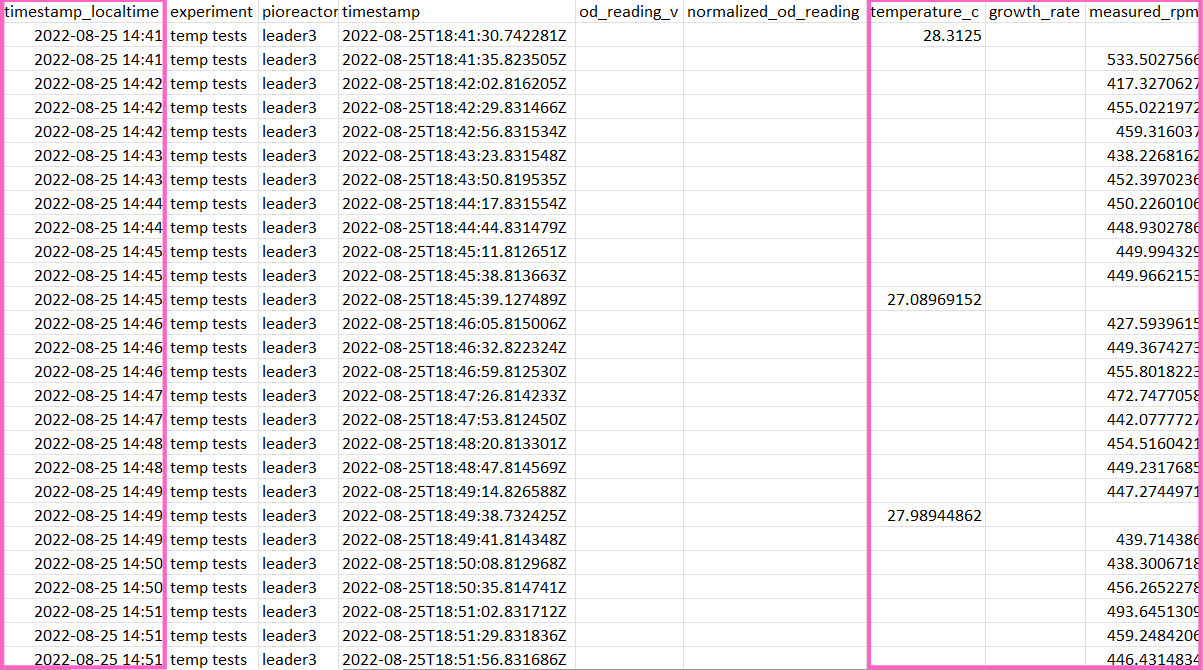
This dataset summarizes all activities from one Pioreactor against a single time series to make working with data easier. The dataset will follow a running timeseries (column A) and include metrics for OD, temperature, stirring, LED updates and dosing.
Consider this example where we turned on temperature and stirring:
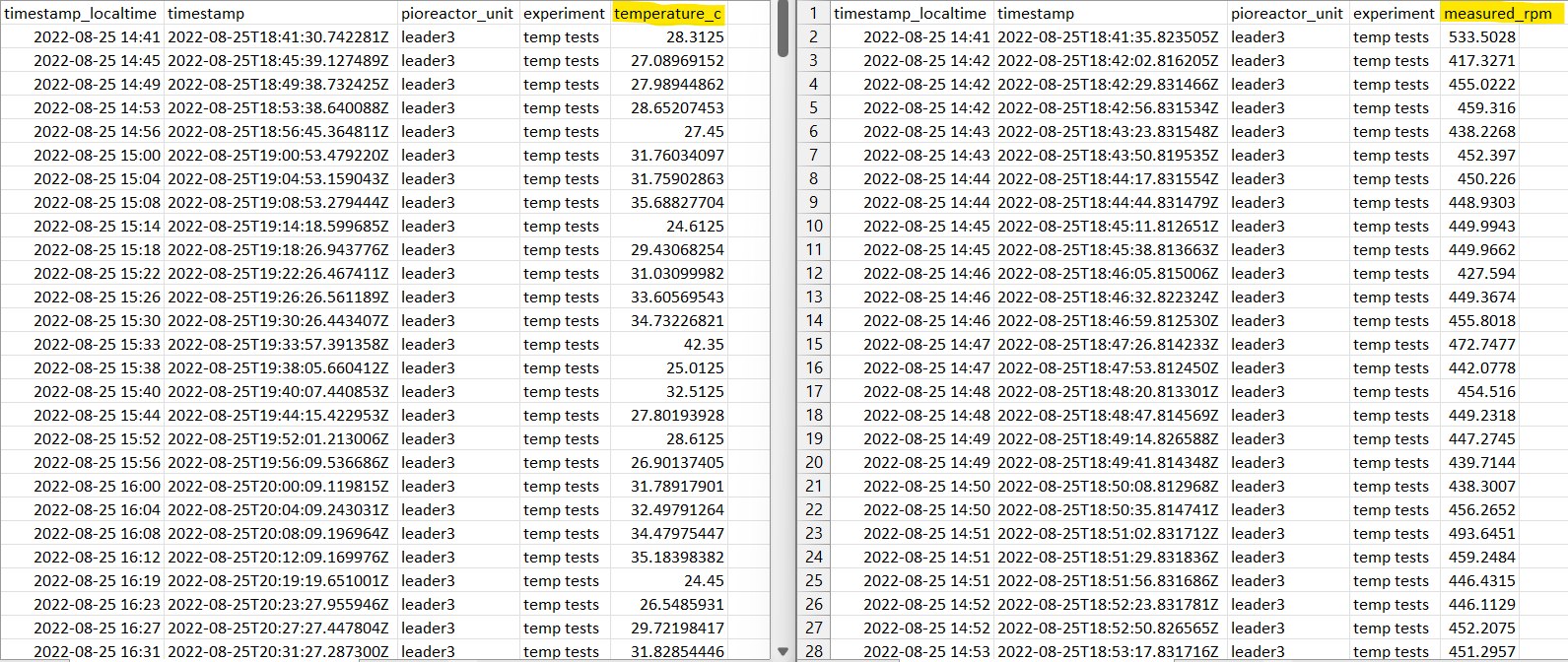
Temperature and stirring datasets are exported on separate .csv files and follow their unique time series. In comparison, the Pioreactor Unit dataset compiles both against the same time series, making it much more accessible: